I want my van to have some modern conveniences like a fridge and a way to charge my phone, which means I need a way to generate electricity. Given that commercial motor vehicle mounted nuclear reactors haven’t hit the market yet, I opted for solar.
Having a small van, I don’t have much roof space- a problem made worse by the racks already installed on the roof. I could take them off, but in doing so I would create more holes in my roof, so I decided to work around them. I was able to find a 100 watt panel that is just narrow enough that I can fit two of them between my racks. I opted for flexible solar panels for a lower profile and ease of installation, but I still want to be able to service and or replace them if needed. So as crazy as it sounds, I installed my panels with velcro.
The more common ways of installing flexible solar panels on a van involve very heavy duty adhesives or drilling holes in the roof. When I saw a couple of people who had installed their panels via velcro, I saw a solution that avoids drilling more holes in the roof but still lets me swap out the panels if I need to.
With some the most resilient velcro I could find and some very heavy duty duct tape, I got to installing the panels. I cut the velcro into strips, stuck it to the raised parts of the roof, and then laid the panels down on top of it. There really isn’t that much area where the panels actually contact the roof, but I had hoped this would help provide an air gap between the panels and the roof. Adding panels to a roof can make the interior of the van much hotter, so having some air in between the panels and the roof can help mitigate that. Lastly I put some duct tape on the leading edge; I’ve heard that if you get going at speed the wind under the panels can be enough to rip the panels clean off the roof otherwise. I’m a little skeptical, but better safe than sorry.
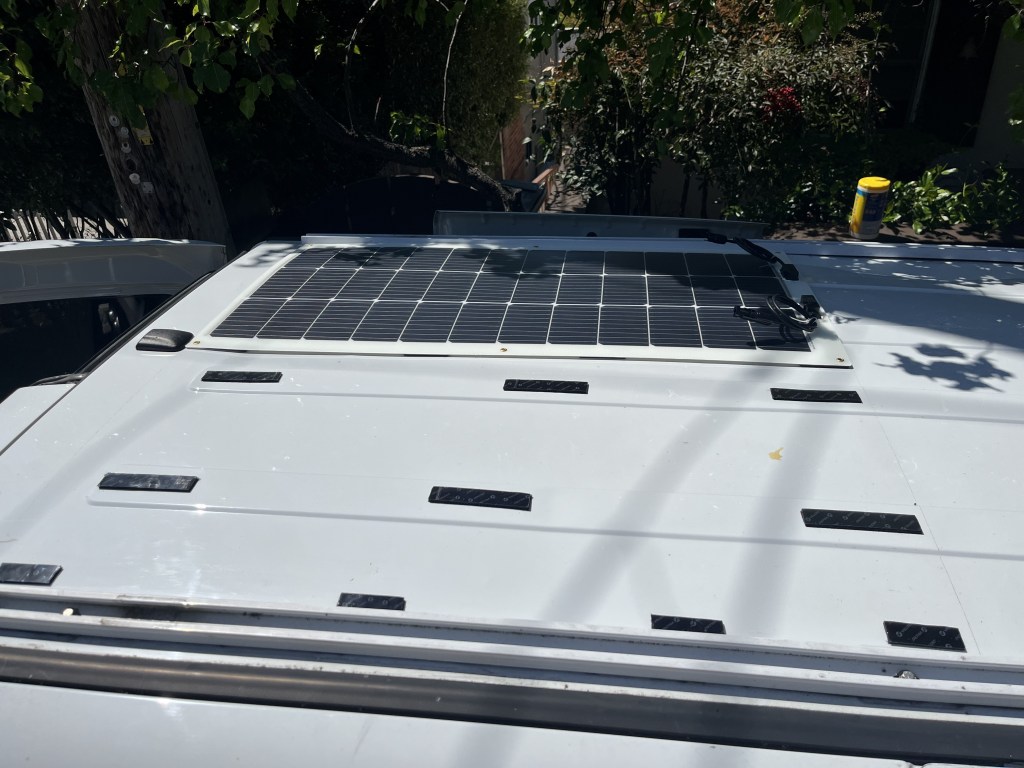
Even velcro couldn’t save me from drilling a couple holes in my roof though. To run the cables from the panels to my electrical board, I drilled two holes in my roof and put cable glands in. When I have everything set, I’ll add some sealant around the edges, and hopefully it’ll be leak free.
After one road trip in the sun and wind, the panels are holding up just fine. They certainly make the interior of the van much warmer, but hopefully once I finish insulating this will be manageable. I’ll keep an eye on the velcro as it gets exposed to more heat and cold and wind and water, and if it doesn’t hold up, I’ll pick a different mounting method and do that instead. To me this is one of the benefits of building the van myself. I can take risks like this and keep an eye on them so hopefully I catch anything before it gets too problematic. If it ultimately doesn’t work, I learned something and I’ll know the system well, which will make fixing it easier.